
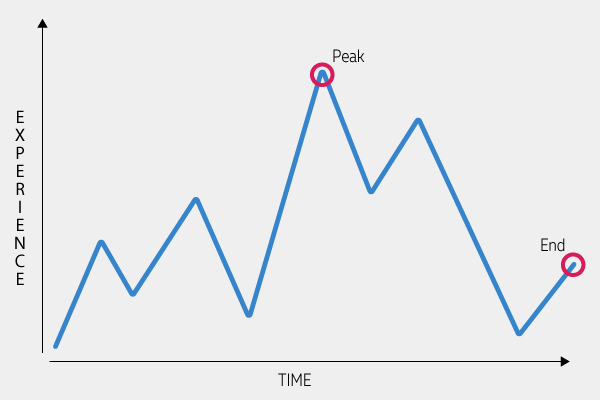
The idiom of “ending things on a high note” is more important than you may think in both your business and personal life.
Our minds are economical when storing information. So we only tend to recall snapshots of the overall event which then shapes our feelings about it.
If you’re a brand that values your customer’s experience (you should be) the Peak-End rule is something you need to be aware of. Doing so allows you to focus your efforts on moments that matter and avoid negative perceptions of your brand.
What Does The Peak End Rule Mean?
The peak-end rule also known as the peak-end theory is a psychological heuristic that impacts how we remember things. We tend to heavily weigh our judgement of an experience on how we felt at the most emotionally intense moment, good or bad (peaks) as well as how we felt at the end, hence the name.

So what does the Peak End Rule mean for your brand?
Because people’s recollection of events is heavily weighted on the finale and the “peaks” the quickest way to improve customer experience is to focus on these points in the journey. Such as following up on a bad experience with an exceptional one and having a plan in place so the end of the journey is always positive.
You don’t want your customer’s experience to be like the Game of Thrones Series. Great all the way through but spoiled by a terrible ending!
So first thing’s first, map out your customer personas journeys. You should start to see where the peaks (and troughs) are located. Be sure to include your sales team and customer service team in this process so you don’t miss anything. Now note down the ending, highs and low points.
Now that you’ve identified the moments you want to address it’s time to brainstorm how you can amplify the good experiences and remedy the bad. You should also have a process in place to ensure every customer finishes on a high note.
This could be things like helping the customer carry a heavy object to their vehicle, finishing with a delicious dessert at a restaurant or offering discounts or compensations when a problem occurs.
What are some examples of the Peak End Rule?
Theme Park Experiences
Cast your mind back to your last trip to a theme park. Chances are the memories are of enjoying the rides, watching the fireworks or maybe the absolute terror you had because you were peer pressured to go on that rollercoaster you didn’t want to.
What unlikely comes to mind first is the hour-long queue you had leading up to it. This is the peak-end rule in action and part of the reason why people flock to them even during peak season.

Free Burrito Card
I was recently going through a drive-through at one of my favourite fast-food restaurants and due to whatever reason, there was a much longer wait time than normal. What went from looking forward to one of my favourite meals was turning into a frustrating chore.
Eventually, the food was ready and included was a card for a free burrito. This was not expected and completely changed my memory of the situation. What went from a bad experience changed to a great one because of finishing on a positive.
Pain Preferences
The peak-end rule has been thoroughly studied in medical procedures and it’s found that patients prefer to have lengthier procedures that include a period of decreased discomfort over uncomfortable shorter procedures. And a painful medical treatment is less aversive if relief of the pain is gradual than if it’s abrupt.
In a study in 1996 by Kahneman and Redelmeier, colonoscopy patients rated their discomfort from the procedure.
Regardless of the length of the procedure or the pain intensity experienced, all colonoscopy patients evaluated their procedure based on the peak events and ending sentiments.
Understanding how people form memories of invasive screening procedures like this can save lives by making the experience more pleasant and thus more likely to be frequently conducted.
Using Promotional Merchandise To Create “Peaks”
Because of the unexpected delight factor of promotional merchandise, they are very effective at improving nearly any customer journey.
Many of the businesses we have helped with use merchandise post-sale either as a gift with purchase or to empower brand advocates.
Everyone loves a freebie so promo is one of the perfect tools to take advantage of the peak-end rule.
In Summary
People don’t remember entire experiences instead the memory is heavily weighted based on the peaks and the ending.
Therefore these are the points in the customer journey you want to focus on if you want to push the needle.
Promotional merchandise is an effective way to add unexpected delights into your customer’s journey. Find the perfect product today by browsing the range below or speaking with a branding specialist.


Matt has spent over eight years in Australia’s promotional products industry. As part of the Promotion Products marketing team, he manages product catalogues and content, keeping brands up to date with what’s new and what works. A contributor to the APPA Magazine, Matt brings practical insight into how quality merch helps businesses stand out.